THE POLITICAL ECONOMY PROJECT
  • Home
  • Book1
    • Book1 Intro
    • Book1 Chapter 1
    • Book1 Chapter 2
    • Book1 Chapter 3
    • Book1 Chapter 4
    • Book1 Chapter 5
    • Book1 Chapter 6
    • Book1 Chapter 7
    • Book1 Chapter 8
    • Book1 Chapter 9
    • Book1 Chapter 10
    • Book1 Chapter 11
  • Workshops+
    • Images
    • Workshop 4
    • Workshop 1 >
      • Images
      • Images
    • Workshop 2 >
      • Images
    • Workshop 3
    • Workshop 5 >
      • Images
    • Workshop 6 >
      • Images
    • Workshop 7 >
      • Images
    • Workshop 8 >
      • Images
  • Book Prize
    • 2016 Book Prize
    • 2017 Book Prize
    • 2018 Book Prize
    • 2019 Book Prize
    • 2020 Book Prize
    • 2022 Book Prize
    • 2023 Book Prize
  • Pedagogy
  • PEPBLOG
  • Summer Institute
    • PESI 2024
    • PESI 2023 >
      • 2023: Student Bios
      • 2023: Educator Bios
    • PESI 2022 >
      • 2022: Educator Bios
      • 2022: Student Bios
    • PESI 2021 >
      • 2021: Educator Bios
    • PESI 2019 >
      • 2019: Educator Bios
      • 2019: Student Bios
    • PESI 2018 >
      • 2018: Educators and Students >
        • 2018: Educator Bios
        • 2018: Student Bios
    • PESI 2017 >
      • 2017: Educators and Students >
        • 2017: Educator Bios
        • 2017: Student Bios
    • PESI 2016 >
      • 2016: Educators and Fellows >
        • 2016: Educator Bios
        • 2016: Fellow Bios
  • Network
    • Maha Abdelrahman
    • Samer Abboud
    • Ziad Abu-Rish
    • Gilbert Achcar
    • Max Ajl
    • Anne Alexander
    • Kristen Alff
    • Paul Amar
    • Habib Ayeb
    • Charles Anderson
    • Hannes Baumann
    • Joel Beinin
    • Brenna Bhandar
    • Samia Al-Botmeh
    • Firat Bozcali
    • Melani Cammett
    • Joseph Daher
    • Omar Dahi
    • Tariq Dana
    • Firat Demir
    • Kaveh Ehsani
    • AbdelAziz EzzelArab
    • Leila Farsakh
    • Wael Gamal
    • Mélisande Genat
    • Bassam Haddad
    • Adam Hanieh
    • Toufic Haddad
    • Vladimir Hamed-Troyansky
    • Shir Hever
    • Jamil Hilal
    • Raymond Hinnebusch
    • Firas Jaber
    • Aaron Jakes
    • Toby Jones
    • Arang Keshavarzian
    • Raja Khalidi
    • Laleh Khalili
    • Paul Kohlbry
    • Darryl Li
    • Zachary Lockman
    • Miriam Lowi
    • Rabab El Mahdi
    • Pete Moore
    • Roger Owen
    • Nicola Pratt
    • Kareem Rabie
    • Sahar Taghdisi Rad
    • Iyad Riyahi
    • Roberto Roccu
    • Sara Roy
    • Omar Jabary Salamanca
    • Sobhi Samour
    • Sherene Seikaly
    • Omar AlShehabi
    • Linda Tabar
    • Alaa Tartir
    • Mandy Turner
    • Shana Marshall
    • Ahmad Shokr
    • John Warner
    • Emrah Yildiz
    • Sami Zemni
    • Rafeef Ziadah
    • Kiren Chaudhry
    • Basma Fahoum
    • Kevan Harris
    • Jamie Allinson
    • Johan Mathew
  • About
  • Summer Institute (Internal)
    • Materials >
      • 2023 Readings
  • Applications
Picture


​MATERIALS
​


PESI 2019 SCHEDULE

Your browser does not support viewing this document. Click here to download the document.
DAY ONE: Friday 7 June 
4441 George Mason Blvd Merten Hall, Room 1204
Pickup: 9:20

10:00-11:30: Core Session 1 (Elyachar)
 
11:30-11:50: 20 Minute Break
 
11:50-12:45: Brief Session 1 (Haleh-Davis)

12:45-2:00: Lunch
 
2:00-3:30: Thematic Panel 1 (Professional Development)

3:30-3:50: 20 Minute Break

3:50-4:45: Brief Session 2 (Abboud)

4:45-5:00: 15 Min Break

5:00-6:30: Book Talk/Public Event

6:30: Group Dinner
​

DAY TWO: Saturday 8 June (Merten Hall 1204)
4441 George Mason Blvd Merten Hall, Room 1204
Pickup: 8:20

9:00-10:30: Core Session 2 (Moore)

10:30-10:50: 20 Minute Break

10:50-11:45: Student Breakout 1

11:45-12:05: 20 Min Break

12:05-1:00: Brief Session 3 (Marshall)

1:00-2:15: Lunch

2:15: Core Session 3 (Ajl)

3:45-4:05: 20 Min Break

4:05-5:00: Thematic Panel 2 (Neoliberalism)

5:30: Dinner on your own.
[Faculty meeting on MESPI.]
DAY THREE: Sunday, 9 June 2018
Johnson Center 334 (Meeting Room E)
P
ickup: 9:20

10:00-11:30: Core Session 4 (Abu-Rish)

11:30-11:50: 20 Minute Break

11:50-12:45: Brief Session 4 (Haddad)

12:45-2:00: Lunch

2:00-3:00: Student Breakout 2

3:00-3:20: 20 Minute Break

3:20-4:45: Core Session 5 (Hanieh)

4:45- 5:05: 20 Minute Break

5:05-6:00: Student Breakout 3

6:00: On-site group Dinner


DAY FOUR: Monday 10 June 
4441 George Mason Blvd Merten Hall, Room 1204
Pickup: 8:20

9:00-10:30: Core Session 6 (Ziadah)

10:30-10:50: 20 Min Break

10:50-11:50: Student Breakout 4

11:50-12:50: Working Lunch (review)

12:50-2:20: Core Session 7 (Rabie)

2:20: END of PESI

PESI 2019 FELLOW PROJECTS

  • Camille Cole (Yale University): Bandit Capitalism: Nineteenth Century Basra between Empires
  • Zachary Smith (University of Pennsylvania): Colonial Accumulation: Institutions and Ideologies in Settler Societies
  • Sari Madi (University of Montreal / CRIMT): The political economy of legal changes in the MENA region: evidence from Tunisia and Lebanon
  • Patrick Higgins (The University of Houston): Title TBA
  • Lucy Garbett (UC Irvine): Social Reproduction, Neoliberalism, and Resistance: the Politics of Care in Palestine
  • Jonathan Viger (York University): Historicizing the Political Geography of the post-Ottoman Middle East: Social Conflicts, Competing Sovereignties, and Changing Territoriality
  • Gabriel Young (NYU): Between and Beyond the Country and the City: Basra, Iraq, and Urbanization in the Twentieth-Century Persian Gulf
  • Gabi Kirk (UC Davis): Cultivating and Claiming Indigeneity: Agriculture, Capitalism, and Settler-Colonialism in Palestine-Israel
  • Brittany Cook (University of Kentucky): Geopolitical Ecologies of Agricultural Development: A Comparison of Olive Oil Production in Jordan and Palestine​
  • Arash Davari (Whitman College): The Politics of Disavowal: Revolutionary Iran in the Wake of 68
  • Aras Koksal (University of Minnesota): Farmers to Engineers? Higher Education and Social Change in Neoliberal Turkey
  • Layla Hashemi (George Mason University): Media and Resistance in the Islamic Republic of Iran (IRI)

PESI 2019 READINGS

[Please do not redistribute or share these readings outside of the summer institute]
[click the citations to view session readings]

Ziad Abu-Rish: State Formation and Market Development​
​
Reading List:
  • Eugene Rogan, “Ottomans: Establishing a Permanent Presence in Transjordan,” in Frontiers of the State in the Late Ottoman Empire: Transjordan, 1850-1921 (Cambridge University Press, 2002), 44-69.
  • Eugene Rogan, “Merchants,” in Frontiers of the State in the Late Ottoman Empire: Transjordan, 1850-1921 (Cambridge University Press, 2002), 95-121.
  • Tariq Tell, “The Infrastructure of Mandatory Power in the Towns,” in The Social and Economic Origins of Monarchy in Jordan (Palgrave 2013), 73-82.
  • Tariq Tell, “The Infrastructure of Mandatory Power in the Steppe,” in The Social and Economic Origins of Monarchy in Jordan (Palgrave 2013), 83-94.
  • Tariq Tell, “From Mandate to Kingdom: The Social Origins of Hashemite Power in the Sown,” in The Social and Economic Origins of Monarchy in Jordan (Palgrave 2013), 95-112.
  • Steven Heydemann, “The Rise and Decline of the Idea of a Social Pact,” in Authoritarianism in Syria: Institutions and Social Conflict, 1946-1970 (Cornell University Press, 1999), 30-54.
  • Steven Heydemann, “State, Capital, and the Organization of Social Capital,” in Authoritarianism in Syria: Institutions and Social Conflict, 1946-1970 (Cornell University Press, 1999), 55-83.
  • Elizabeth Picard, “The Political Economy of Civil War in Lebanon,” in War, Institutions, and Social Change in the Middle East, edited by Steven Heydemann (University of California Press, 2000).​

Max Ajl: The Rural Question and Peasant Economy​

Reading List:
  • Henry Bernstein (2006), "Is There an Agrarian Question in the 21st Century?" Canadian Journal of Development Studies / Revue canadienne d'études du développement, 27:4, 449-460
  •  Miguel A. Altieri (2009),  "Agroecology, Small Farms, and Food Sovereignty." Monthly Review, 34-42.
  • Sam Moyo, Praveen Jha and Paris Yeros (2013), "The Classical Agrarian Question: Myth, Reality and Relevance Today." Agrarian South: Journal of Political Economy, 2:93 DOI: 10.1177/2277976013477224.
  • Harriet Friedmann (2000). "What on Earth is the Modern World-System? Foodgetting and Territory in the Modern Era and Beyond." Journal of World-Systems Research, 11:2, 480-515.

Julia Elyachar​: Postcolonialism and Political Economy of the Middle East

[Dr. Elyachar's note: Since this is too much material to read for one seminar, please focus on what is most helpful for you. The presentation should present the line of thought in a way that makes it unnecessary to have read everything. Download Dr. Elyachar's complete reading list and summary here.]

Reading List:
  • Marx’s Capital: Volume I, Penguin Edition.
       - Chapter 1: “The Commodity”
        - Chapter 27: “The Expropriation of the Agricultural Population     from the Land”
       - Chapter 29: “The Genesis of the Capitalist Farmer” (with footnotes)             
  • Aijaz Ahmad, “Orientalism and After: Ambivalence and Cosmopolitan Location in the Work of Edward Said,” in Economic and Political Weekly, Vol. 27, No. 30 (Jul. 25, 1992), pp. 98- 116. 
  • Özgür Türesay. “The Ottoman Empire Seen through the Lens of Postcolonial Studies: A Recent Historiographical Turn.” Revue d’histoire modern contemporaine. 2013/2 (No. 60- 2).
  • Selim Deringil. “‘They Live in a State of Nomadism and Savagery’” The Late Ottoman Empire and the Post-Colonial Debate.” Comparative Studies in Society and History. Vol. 45, No. 2 (Apr. 2003), pp. 311-342.
  • Zeynep Gülsah Çapan and Ayse Zarakol. “Postcolonial colonialism? The Case of Turkey,” in Epstein, Charlotte (ed.) Norming the World: Postcolonial Critiques of the Concept of ‘Norms’ in International Relations. London and New York: Routledge.
  • Lauren Benton. 2010. A Search for Sovereignty: Law and Geography in European Empires, 1400-1900. Cambridge University Press.
       - Chapter 1: Anomalies of Empire, pp. 1-39
       - Chapter 2: Treacherous Places, Atlantic Riverine Regions and          the Law of Treason,” pp. 40-103. (selections)
       - Chapter 5: Landlocked, pp. 222-278.
  • Dieter Grimm, Sovereignty: The Origin and Future of a Political and Legal Concept, (Columbia University Press, 2015).
  • Antony Anghie, “Colonialism and the birth of international institutes: the Mandate System of the League of Nations,” in Imperialism, Sovereignty, and the Making of International Law, Cambridge University Press, 2005.​


​
Adam Hanieh: Finance Capital and Financialization of the World Economy

Reading List: 
  • Aalbers, M.B. (2019) “Financialization” In: D. Richardson, N. Castree, M.F. Goodchild, A.L. Kobayashi and R. Marston (Eds) The International Encyclopedia of Geography: People, the Earth, Environment, and Technology. Oxford: Wiley.
  • Ben Fine and Alfredo Saad-Filho,  (2016) “Thirteen Things You Need to Know About Neoliberalism”, Critical Sociology, p.1-22.
  • Ruth Felder (2009) “From Bretton Woods to Neoliberal Reforms: the International Financial Institutions and American Power” in Panitch L., Konings M. (eds) American Empire and the Political Economy of Global Finance. Palgrave Macmillan, London, pp. 175-197.
  • Greta Krippner, (2005) “The financialization of the American economy”, Socio-Economic Review 3, 173–208.
  • Jeff Powell (2018) Towards a Marxist Theory of Financialised Capitalism, Greenwich papers in Political Economy, Greenwich Political Economy Research Centre.
  • Adam Hanieh (2016), “Absent Regions: Spaces of Financialisation in the Arab World”, Antipode, Vol. 48 No. 5
  • Adam Hanieh (2019), “Variegated Finance Capital and the Political Economy of Islamic Banking in the Gulf” New Political Economy (forthcoming) – please do not cite or distribute.
  • C.P. Chandrasekhar and Jayati Ghosh (2017) “The Financialization of Finance? Demonetization and the Dubious Push to Cashlessness in India”, Development & Change, 49(2): 420–436.​

​Pete Moore: The War Economy

Reading List: 
  • Sven Beckert, Empire of Cotton: A Global History (Vintage Books, 2014), pp.29-55.
  • Isa Blumi, Destroying Yemen: What Chaos in Arabia Tells Us About the World (University of California Press, 2018), pp. 113-141.
  • Diego Gambetta, “Mafia: The Price of Distrust,” in Gambetta, Diego (ed.)​ Trust: Making and Breaking Cooperative Relations
  • Steven Heydemann, “War, Institutions, and Social Change in the Middle East,” in War, Institutions, and Social Change in the Middle East, edited by Steven Heydemann (University of California Press, 2000)
  • Toby Jones, “America, Oil, and War in the Middle East,” The Journal of American History, (June 2012).
  • Ali Kadri, Arab Development Denied: Dynamics of Accumulation by Wars of Encroachment (Anthem Press, 2015), pp.115-136.
  • Luis Martinez, The Algerian Civil War: 1990-1998 (Columbia University Press, 2000), pp. 94-146
  • Pete W. Moore, “A Political Economy History of the Jordanian Intelligence Directorate: Authoritarian State Building and Fiscal Crisis.” Forthcoming 2019 Middle East Journal​

Kareem Rabie: Housing, Urbanism and Social Reproduction 

[Dr. Rabie's note: I realize this is more than 200 pages and not all of it will be necessary to open up a conversation. If participants need to skip or to skim some book sections, I suggest they focus on Lefebvre less for the philosophy than for the urban phenomenon/urban dialectic, on chapter 1 of Kwak, and on chapter 5 of Bou Akr. They might also find the Harvey to overlap with material from earlier sessions; the main points I want it to make are that fixed capital is part of the circulation of capital/value in motion, and that it is productive materially and conceptually.]

Reading List:
  • Harvey, D. (2006). The limits to capital. London: Verso. Selections on spatial fix. [Read Chapter 13. Chapter 8 is considered optional additional reading.]
  • Lefebvre, H. (2011). The urban revolution. Minneapolis: University of Minnesota Press. Selections on rural/urban dialectic. [Read Chapters 1 and 3.]
  • Katz, Cindi (2001). "Vagabond Capitalism and the Necessity of Social Reproduction." Antipode 33(4): 709–728.
  • Kwak, Nancy H. (2015). A World of Homeowners: American Power and the Politics of Housing Aid. University of Chicago Press. Selections on housing and ideology. [Read the Intro and Chapters 1 and 6. Chapter 3 is considered optional additional reading].
  • Bou Akar, Hiba (2018) For the War yet to Come: Planning Beirut’s Frontiers. Stanford, California: Stanford University Press. Selections on planning and the future. [Read the Prologue, Chapters 3 and 5, and the Epilogue].​​

Rafeef Ziadah: Circulation, Infrastructures, and Logistics in the Global Economy​

Reading List:
  • Cowen, Deborah. "A geography of logistics: Market authority and the security of supply chains." Annals of the Association of American Geographers 100.3 (2010): 600-620.
  • Pasternak, Shiri, and Tia Dafnos. "How does a settler state secure the circuitry of capital?." Environment and Planning D: Society and Space 36.4 (2018): 739-757.
  • Harvey, David. Seventeen contradictions and the end of capitalism.Oxford University Press, USA, 2014. CHAPTERS 6 AND 11 only
  • Khalili, Laleh. "The Roads to power: The infrastructure of counterinsurgency." World Policy Journal 34.1 (2017): 93-99.
  • Ziadah, Rafeef. "Circulating power: humanitarian logistics, militarism and the United Arab Emirates" [Forthcoming Antipode]

View previous Workshop materials below

AGENDA FOR PESI 2017
LETTER TO STUDENTS 28 MARCH 2017
click below to download the agenda
Picture
​click below to download this letter
Picture

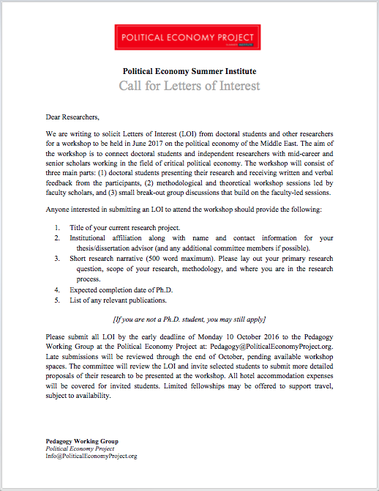
ANNOUNCEMENT FOR THE 2017 WORKSHOP
click below to download this announcement
Picture
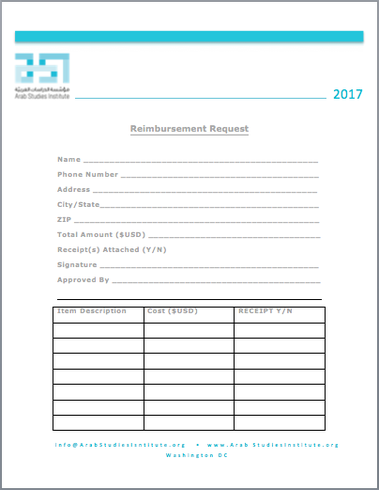
ASI REIMBURSEMENT FORM
 click below to download this form
Picture

READINGS:

[Please do not redistribute or share these readings outside of the summer institute]
[click the citations to view session readings]
Robert Vitalis: Imperialism

Reading List:​​
  • Robert Vitalis, “Introduction” & “Conclusion: The High Plane of Dignity and Discipline” in White World Order, Black Power Politics: The Birth of International Relations (Ithaca: Cornell University Press, 2015).
  • Julian Go, “Introduction,” “Weary Titans: Declining Powers, New Imperialisms,” “The Dynamics of Imperialism,” & “Conclusion” in Patterns of Empire: The British and American Empires, 1688 to the Present (New York: Cambridge University Press, 2011).
Sandra Halperin: State Formation

Reading List [Intro to Readings & Session]:
​​
  • Sandra Halperin, Re-Envisioning Global Development: a ‘Horizontal Perspective’ (London: Routledge, 2013), Chapters 2 (pp. 32-60), 3  (pp. 61-90), and 4 (pp. 91-116).
  • Sandra Halperin, “The Post-Cold War Political Topography of the Middle East: Prospects for Democracy.” Third World Quarterly 26:7 (December 2005), 1135-1156.
  • Sandra Halperin, ‘Power to the People: nationally-embedded development and mass armies in the making of democracy’, Millennium: Journal of International Studies 37:3 (May 2009), 605-630.
  • Nazih Ayubi, Overstating the Arab State: Politics and Society in the Middle East. London: I.B. Tauris, 2009; Chapter 1 (pp. 1-37).

Max Ajl: World Systems Theory

​​Reading List:
  • Karl Marx, Grundrisse, introduction.
  • Dale Tomich, “Small Islands and Huge Comparisons,” Social Science History 18, no. 03 (1994): 339–358.
  • Tosun Aricanli and Mara Thomas, “Sidestepping Capitalism: On the Ottoman Road to Elsewhere,” Journal of Historical Sociology 7, no. 1 (1994): 25–48.
  • Philip McMichael, “Incorporating Comparison within a World-Historical Perspective: An Alternative Comparative Method,” American Sociological Review 55, no. 3 (June 1990).
  • Fernando Henrique Cardoso and Enzo Faletto, Dependency and Development in Latin America (Dependencia Y Desarrollo En América Latina, Engl.) (Univ of California Press, 1979), preface to English edition.
  • Janet Abu-Lughod, “Restructuring the Premodern World-System,” Review (Fernand Braudel Center), 1990, 273–286.
  • Terence K. Hopkins, “World-Systems Analysis, Methodological Issues,” in Immanuel Wallerstein, Terence K. Hopkins, and others, World-Systems Analysis: Theory and Methodology (Beverly Hills: Sage, 1982), pp. 145-158.

Suggested Readings:

  • Samir Amin (1974) “Accumulation and development: a theoretical model,” Review of African Political Economy, 1:1, pp. 9-26.
  • Ali Kadri, “Islam and Capitalism: Military Routs, Not Formal Institutions,” Handbook of Alternative Theories of Economic Development, 2016, 161.
Joel Beinin: Labor

Reading List:
​
  • Hanan Hammad, Industrial Sexuality: Gender, Urbanization, and Social Transformation in Egypt (University of Texas Press, 2016), 1-24.
  • Hanan Hammad, Industrial Sexuality: Gender, Urbanization, and Social Transformation in Egypt (University of Texas Press, 2016), 78-105.
  • Andrea Grace Wright, Migratory Pipelines: Labor and Oil in the Arabian Sea (Ph.D. thesis, Anthropology and History, University of Michigan, 2015): Chapter 1, pg. 1-30.
  • Andrea Grace Wright, Migratory Pipelines: Labor and Oil in the Arabian Sea (Ph.D. thesis, Anthropology and History, University of Michigan, 2015): Chapter 1, pg. 31-60.
  • Andrea Grace Wright, Migratory Pipelines: Labor and Oil in the Arabian Sea (Ph.D. thesis, Anthropology and History, University of Michigan, 2015): Chapter 3, pg. 103-126.
  • Andrea Grace Wright, Migratory Pipelines: Labor and Oil in the Arabian Sea (Ph.D. thesis, Anthropology and History, University of Michigan, 2015): Chapter 3, pg. 126-150.
  • Joel Beinin, "Foreword to the Turkish edition of Workers and Peasants in the Modern Middle East” (© January 2017), 1-21.

Sherene Seikaly: Postcolonial Theory

​​
Reading List:​
  • Susan Buck-Morss, “Envisioning Capital: Political Economy on Display,” Critical Inquiry 21:2 (Winter 1995).
  • Michel Foucault, Part III: Discipline,” in Discipline and Punish (New York: Vintage Books, 1995, 1977).
  • Gayatri Chakravorty Spivak, “Can the Subaltern Speak?” in Carry Nelson and Lawrence Grossberg (eds), Marxism and the Interpretation of Culture (London: Macmillan, 1988).
Samer Abboud: Security-Development Nexus

​
Reading List:
  • Mark Duffield, “Introduction” & “The Merging of Security and Development” in Global Governance and the New Wars: The Merging of Security and Development (London: Zed Books, 2001).
  • Sophia Hoffman, “Humanitarian security in Jordan’s Azraq camp,” Security Dialogue 48:2 (2017), 97-112.​
  • Maria Stern and Joakim Ojendal, “Mapping the Security-Development Nexus: Conflict, Complexity, Cacophony, Convergence?” Security Dialogue 41: 1 (February 2010), 5-29.
  • Nell Gambiam, “Humanitarianism, Development, and Security in the 21st Century: Lessons from the Syrian Refugee Crisis,” International Journal of Middle East Studies 48: 2 (May 2016), 382-386.
  • Rita Abrahamsen and Michael C. Williams, “Security Beyond the State: Global Security Assemblages in International Politics,” International Political Sociology 3:1 (March 2009), 1-17.​
  • David Chandler, “The security-development nexus and the rise of ‘anti-foreign policy,’” Journal of International Relations and Development 10: 4 (December 2007), 362-386.

Max Ajl: Agriculture

​​Reading List:
  • Bernstein, Henry “V.I. Lenin and A.V. Chayanov: looking back, looking forward,” Journal of Peasant Studies, 36: 1, 55 — 81
  • Duncan, C. “The Centrality of Agriculture: History, Ecology and Feasible Socialism.” Socialist Register 36, no. 36 (2009).
  • Moyo, Sam, Praveen Jha, and Paris Yeros. “The Classical Agrarian Question: Myth, Reality and Relevance Today.” Agrarian South: Journal of Political Economy 2, no. 1 (2013): 93–119.
  • Friedmann, Harriet. “World Market, State, and Family Farm: Social Bases of Household Production in the Era of Wage Labor.” Comparative Studies in Society and History 20, no. 4 (October 1, 1978): 545–86.
  • McMichael, P. “Rethinking Globalization: The Agrarian Question Revisited.” Review of  International PoliticaI Economy 4, no. 4 (1997): 630–662.
  • Patnaik, Utsa. “Some Aspects of the Contemporary Agrarian Question.” Agrarian South: Journal of Political Economy 1, no. 3 (December 1, 2012): 233–54.
  • Shanin, Thedor. “Chayanov's treble death and tenuous resurrection: an essay about understanding, about roots of plausibility and about rural Russia,” Journal of Peasant Studies, 36, 1 (2009) 83-101.
 
Suggested Readings:
​
  • Henry Bernstein (2016) Agrarian political economy and modern world capitalism: the contributions of food regime analysis, Journal of Peasant Studies, 43:3, 611-647
  • Philip McMichael (2016) Commentary: Food regime for thought, Journal of Peasant Studies, 43:3, 648-67
  • Harriet Friedmann (2016) Commentary: Food regime analysis and agrarian questions: widening the conversation, Journal of Peasant Studies, 43:3, 671-692
Picture

[email protected]  -  [email protected]

Picture